

When cancelling a product, would a ‘cancellation assistant’ '(Try it out!) help better than having to jump through hoops just to cancel your subscription? And could it do better? And as a company, should you hold on to a user that is already thinking of cancelling or should you admit you as a company did not deliver on a promise? And is a cancellation proces the best moment to figure this out?
Without picking on Beehiiv, which I choose to start even after having checked out Substack platform on which I’m writing this very article, it was eventually to complex for me as a starter, hoping to make way to a public that could become interested in some of the things I write. And therefore, also too expensive.
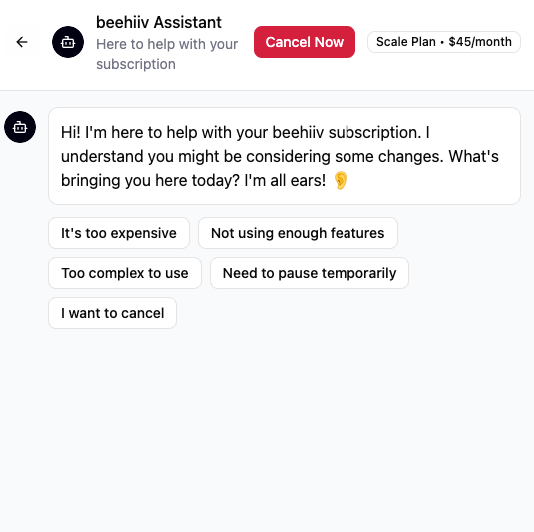
It was only when cancelling my subscription, that I did however started to wonder on how they made me jump through different hoops, just to get my subscription cancelled. It reminded me of dark patterns, where you get demotivated to or get misleaded into something else, when cancelling your subscription.
What this shows is a real friction between a KYC (Know Your Customer)-process getting in the way of the user’s intent who is genuinely considering cancelling their subscription. Sprinkle some behavioural learnings on top of that which tells us a user can start to doubt, reconsider their initial intent, maybe discover a promotion or different plan and what you get is in this case a very cumbersome process that:
- Just takes too long
- Takes up too much cognitive load
- Could make the user really get annoyed (eg. this article is the living proof of that)
- Does not make the user trust the company any more next time around (and yes, users do come back to figure out if something has improved)
Could it sometimes lead to higher retention and less users dropping off? Absolutely! But should you track if in the long run you’ll get brand erosion? That as well! Common sense tells me some experiences will linger on longer than needed.
Without pretending to have a clear answer, i could imagine a cancellation flow that gets rid of the doubt and respects the user initial intent by straigthforwardly offer creative solutions to their doubt. And even, respectfully after cancellation, try to make them stick around. It remains a thin line, where gains can be made, and doubtful users can become ambassadors again. It can make for annoyance and bad word of mouth as well.
You can follow my conversation with Gemini in the following document: Cancellation process Beehiiv or try out a cancellation assistant that perhaps has more respect for what you set out to initially do.