

Hey Labor! wake up and smell the napalm. Startups and enterprises are not selling directly to you anymore… at least not if they don’t need to. The game is changing.

They’re not advocating for your productivity. They’re advocating for the business’s productivity, irregardless wether this comes from humans (labor) or agents (capital). They’re convincing capital allocators. You know them as CFOs, VPs, program managers, project leads—the people who ask “Why should this take that much time and resources?” and “How much additional value will we get by spending X?”
New startups, fresh graduates, college dropouts, veterans seeking new opportunities are looking to bypass you. They’re going straight to the decision makers. They won’t necessarily advocate for efficiency or productivity on your behalf, or try to measure any other difficult metrics in your name. They’re courting capital directly.
You’ll get to know them as Your AI Chief of Staff, Max: your autonomous AI recruiting partner, The first autonomous ML Engineer, Julius The AI Data Analyst, Cora is the $150,000 chief of staff that only costs $15 per month, Donna: The only proactive AI assistant for field sales, Lindy: your first AI employee, Delty: Your AI staff engineer,… while some will propose working alongside with you excelling in specific tasks you maybe would not want to do at all: AI Voice Agents for Patient Access and RCM, Freckle sits on top of your CRM, auto-enriching every record coming in from any source, … or they give you the option to Hire ready-made digital workers or create a custom digital workforce tailored to your business, Build and deploy AI agent workflows, Hire and set up enterprise-grade AI Employees within minutes, not months, …and so on. Some are even harsh about it and suggest us to even directly Fire our GTM Engineer!
Yet when I list these claims to fame, the theme start to feel like a recurring meme. Perhaps this isn’t new at all—maybe I’m just engaging in familiar fearmongering. We’ve witnessed similar waves before, each promising that digital solutions would completely reshape work:
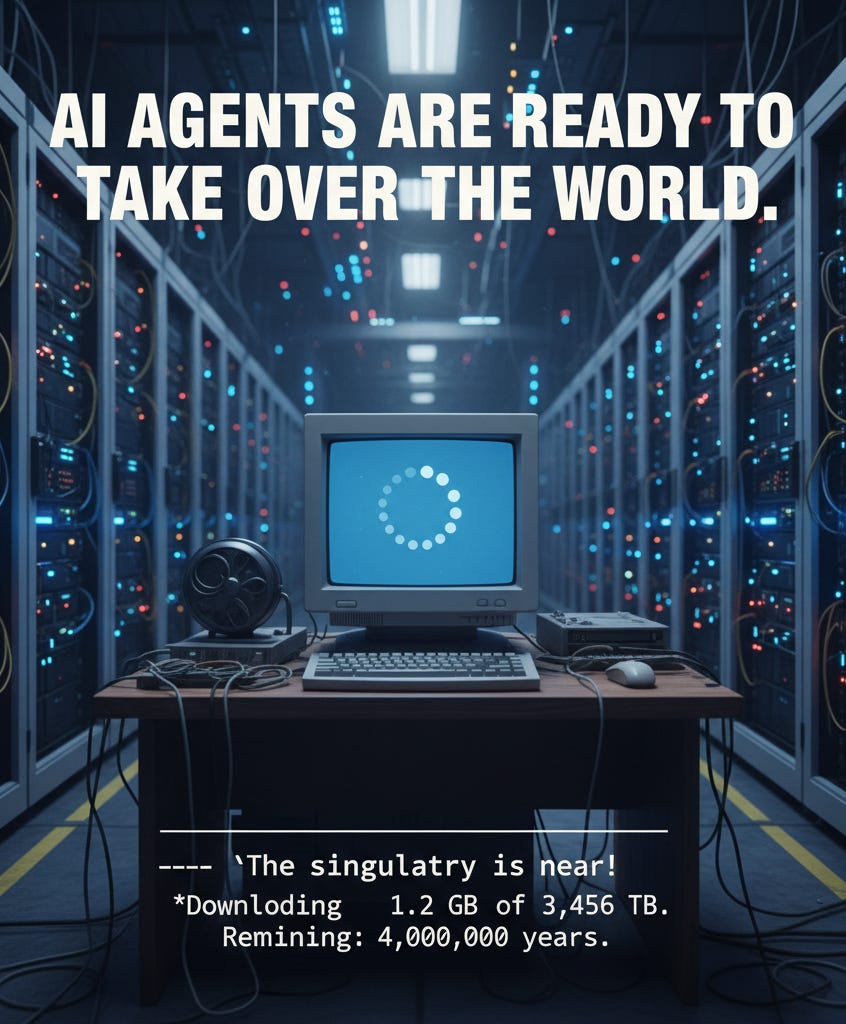
Software was supposed to replace manual labor entirely. SaaS and automation would streamline digital workflows until humans became obsolete. Chatbots were heralded as the universal substitute for customer intake, communication, and ticket handling.
None of these predictions fully materialized—at least not yet (as the meme shows, it still has a hard time replicating pure words or sentences in an image, eg. singulatry / downloding /remining)
(Fearmongering mode: back on)
We may be witnessing a fundamental shift in how businesses operate. Unlike previous technological waves, the current AI revolution is empowering companies—from enterprises to solo founders—to purchase productivity directly rather than hire for it. This capital-first approach treats human expertise as an expense to be optimized rather than an asset to be cultivated.
The business logic is straightforward: every company ultimately balances costs against revenue to maximize margins. When studies suggest that AI adoption hasn’t yet proven its productivity promises, many leaders are choosing the safer bet—cutting labor costs with AI tools rather than investing in uncertain AI projects. It’s easier to replace a salary with a software subscription than to navigate the complexities of AI implementation.
As someone currently founding a startup, I’m experiencing this shift firsthand. I’m systematically testing these AI tools and agents, running quick cost-benefit analyses on each one. In my admittedly small sample size of one, many of these solutions genuinely help. They allow me to delay hiring human talent and expertise—not because I don’t value what humans bring, but because I can’t afford an all-star team while I can afford a few hundred to a thousand euros monthly for software that mimics those skills.
This creates a troubling dynamic: entire categories of professionals aren’t even being considered for roles anymore. The consultation phase—where humans would traditionally assess, strategize, and solve problems—is increasingly bypassed in favor of algorithmic solutions.
This raises the defining question of our era: Can we reinvent our professional identities and capabilities at the same speed that AI is targeting the specialized skills we’ve spent years mastering? The race isn’t just between human and artificial intelligence—it’s between human adaptability and technological acceleration.