

If software becomes a factory, and the factory needs ideas, where to better look too than the movie industry, where creativity and rigidness come together to squeeze out masterpiece after masterpiece, both in substance as in delivery.
Should you start looking at founders as producers? And agents (with some humans still) as the crew.
Hollywood promises the following: A producer has an idea and if he’s lucky, within months, hundreds of people are coordinated around it — directors, set designers, sound engineers, casting directors, visual effects teams — all working in parallel, all pointed at the same release date. Intentional. Streamlined. Explosive in output.
And then it’s done. The film ships. The crew disperses. The studio stays lean and moves to the next one.
That’s the most powerful creative operating model ever invented. Massive coordinated bursts of output, on demand, without the overhead of keeping everyone on payroll forever. Hollywood has been doing agile before agile had a name.
But to pull off a Hollywood-style production, you needed a Hollywood-sized budget. Hundreds of specialists don’t show up for free. Coordination at that scale requires producers, assistants, schedulers, department heads. The machinery itself is expensive before a single frame gets shot.
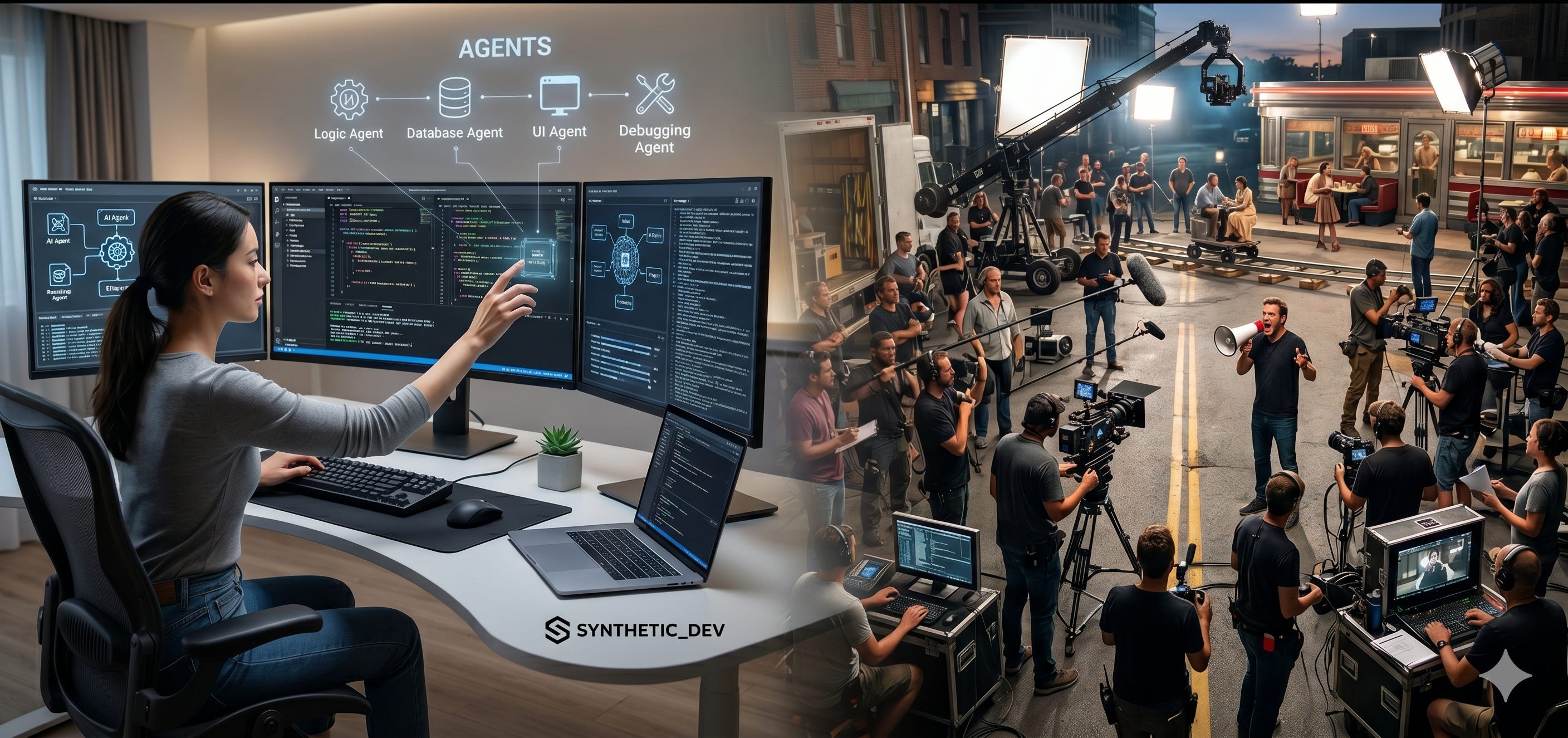
Software had the same ceiling. Want to burst onto the scene with a fully built product, fast, with real depth and polish? You needed a dev agency / in-house dev, designers, a QA team, a data engineer, someone for DevOps, someone for copy. The founding team became a casting office. And the budget needed to match.
That’s why most startups couldn’t really do it. They’d pick one thing, build it as fast as they could and called the scrappiness a virtue.
Maybe that ceiling is going away.
AI coding agents — Cursor, Claude Code, Devin, Lovable — are the engineering crew. Spin them up, point them at the brief, run them in parallel. GitHub reports developers using Copilot complete tasks up to 55% faster. METR showed agents completing multi-hour engineering tasks end to end, autonomously. And that’s before you layer in the rest.
Because it’s not just coding agents. Creative director agents that generate and iterate on brand identity. Ad agents that test fifty concepts overnight. Copy agents, research agents, QA agents, data pipeline agents. The full crew — not metaphorically, but functionally — is becoming available on demand.
A founder with a clear vision can now do what only well-funded studios could do before: burst onto the scene with a fully formed product, fast, with entertainment value, with depth, with polish. The 100-person sprint compressed into a three-person team and three months, not 3 years.
This changes what it means to launch. You can start to look to a real production. Something that feels finished. Something with a moment. They’re operating on a completely different creative register. They’re thinking in productions — what’s the next thing we can burst onto the scene with?
The great producers in Hollywood history were famous for one thing above all else: knowing exactly what they wanted. The crew executes. The vision is yours.
Taste and judgment over raw throughput where you give agents real constraints, real context, real creative direction. And then clarity on what the production is actually for so agents can amplify these decisions. You still make them.
The camera is rolling. The question is who’s behind it.