

The App Store was, for a long time, a genuinely elegant solution to a real problem. You had software. You had users. And between them, you needed something that could establish trust, handle distribution, manage payment, and do it at a scale that made the whole thing worth building in the first place. Apple and Google built. And it worked, still works today, with an annual ‘GDP’ of 1.3 trillion (!) in 2024 in the App Store alone.
What’s changing now is not that the App Store failed. It’s that the assumptions underneath it — the ones that made it the only logical answer — are quietly stopping being true.
The assumptions were these: building software was hard, so you needed professionals. Distribution was scarce, so you needed a gatekeeper with reach. And users couldn’t evaluate safety on their own, so you needed someone to vet things before they arrived. All three made sense. And all three are now being replaced, not by better versions of themselves, but by something structurally different.
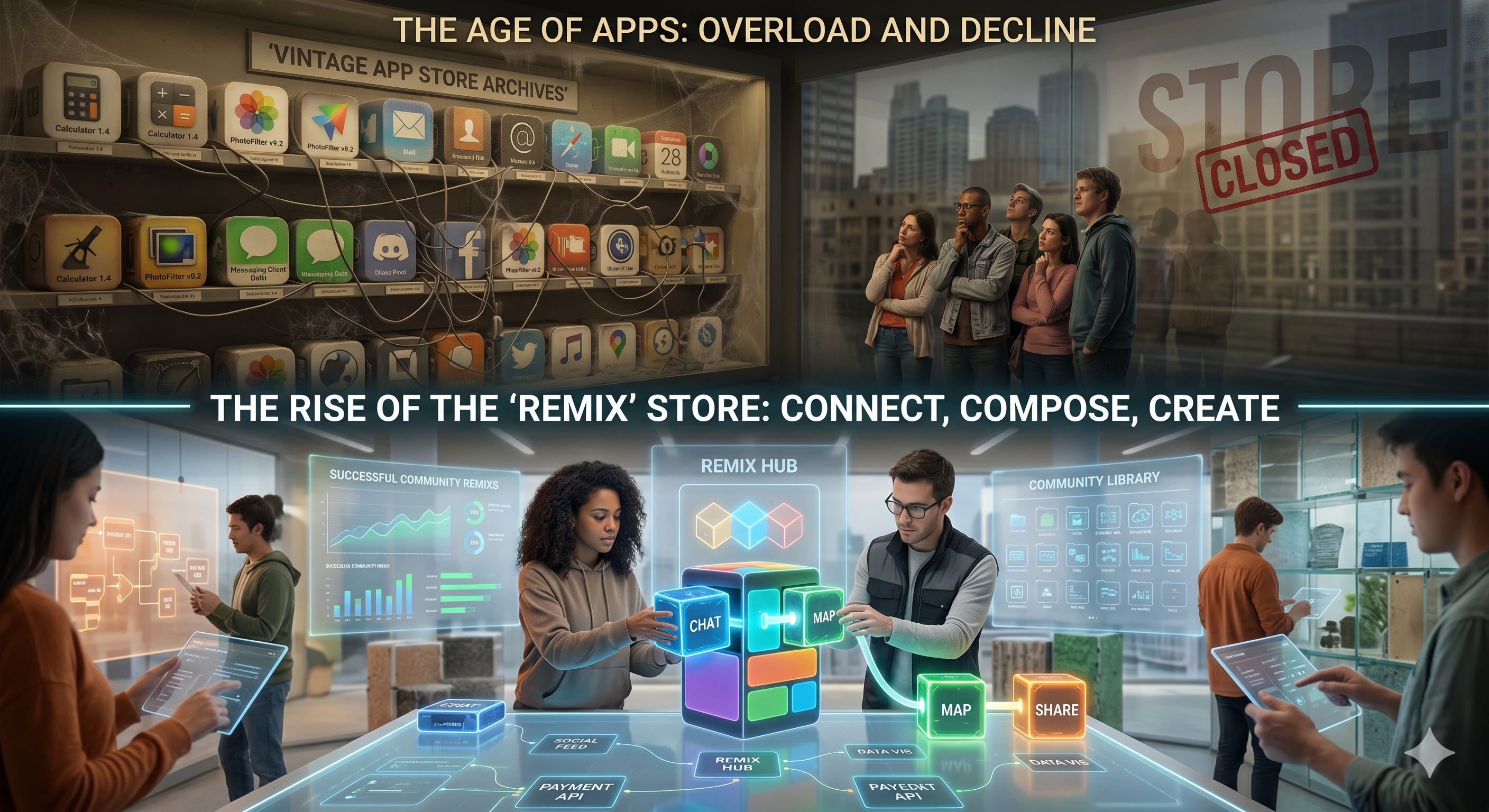
What comes next, I would call the Remix Store. Not because it’s a store yet, or because anyone has built it deliberately, but because that’s the shape of what’s emerging. Less creation from scratch. More building on top of, adapting, sharing forward. Less platform monopoly. More distributed curation. Less one product for millions of people. More one tool for twelve.
Where does the app live now
One of the quieter shifts is geographic, in a digital sense. The App Store placed software on a device. You downloaded it. It sat there. It was yours in a way that implied a certain permanence — you had chosen this, installed it, it was part of your phone’s identity.
Remix apps don’t work like that. They live at a URL, inside a workflow, embedded in a Notion page or a shared Slack channel. They might live inside a conversation. They often don’t have a name anyone would recognize, because they were built for a specific team in a specific week to solve a specific thing, and nobody was trying to make it memorable. The app has become less of a product and more of an output — a byproduct of someone figuring out a problem, which happens to be functional and shareable.
This changes what “having an app” even means. When the location is a link rather than a listing, the whole concept of “installing” dissolves.
For how many people
The App Store was optimized, at every level, for scale. The review process, the pricing models, the onboarding flows — all of it assumed you were building something for a lot of people, ideally millions. The economics of traditional software distribution only made sense if the audience was big enough to justify the investment.
The remix model breaks that assumption at its root. An app built in an afternoon for a team of eight people is not a failed app that didn’t scale. It’s exactly what it was supposed to be. The n=1 use case — one workflow, one context, one small group — has become not just viable but arguably the dominant form of software creation, even if we haven’t caught up to that framing yet.
This matters because so much of how we think about software quality, reliability, and value is still calibrated to the mass-market assumption. When we say an app is “good”, we usually mean it works for a broad audience, handles edge cases, survives the unpredictable. But the remix app has a much more forgiving brief. It just needs to work for the people who are already using it, in the context they already understand. That’s a fundamentally different bar.
Who distributes
Distribution used to require infrastructure. A developer account. A review process. App store optimization, screenshots, localizations, a privacy policy that satisfied compliance teams in multiple jurisdictions. The barrier isn’t just technical — it is also bureaucratic. Which means that whoever navigates it well has a structural advantage over whoever can’t.
That advantage is disappearing. The remix distributor is not a company with a legal entity and a marketing budget. It’s the person who builds a useful tool, shares the link in a group chat, and watches it spread sideways through word of mouth. It’s the consultant who built something for one client and realized the same solution worked for five others. It’s the teacher, the ops manager, the team lead who solved their own problem and accidentally became someone else’s solution.
The interesting thing here is that this doesn’t eliminate curation — it redistributes it. The App Store curated through gatekeeping. The Remix Store curates through social trust, reputation, and the kind of informal peer endorsement that has always been how good tools actually spread inside organizations. The curator was always a person. Now they’re just not employed by Apple.
Security, and who owns it now
This part deserves more honest attention than it’s getting.
The App Store’s review process is genuinely useful, even when it is frustrating. Sandboxing, malware scanning, privacy review — this isn’t only bureaucracy. It is also an infrastructure for trust. When you remove the gatekeeper, you don’t remove the threat. The responsibility is relocated.
A remix app built in twenty minutes by someone who can prompt but can’t audit code, shared across a company’s internal Slack, touching real data and real APIs — that carries real risk. Not hypothetically. Right now. The security layer for remix distribution doesn’t exist in a coherent form yet. Provenance is unclear. Permissions are often not scoped. Audit trails are typically absent.
The honest position is that we are currently trading institutional trust for speed and accessibility, and we haven’t fully reckoned with what that means. Some of it will be fine. Some of it will not. The platforms that figure out how to give remix builders sandboxed environments, clear permission models, and meaningful audit capability — without killing the speed and ease that makes remix building valuable in the first place — will solve something that actually matters.
Why PaaS companies are running this race from the front
The transition from App Store to Remix Store is not primarily a software story. It’s an infrastructure story. And the companies that were already building infrastructure for creation, deployment, and distribution are, almost by accident, in the best position to define what the remix era looks like.
But they are not all positioned equally. There is a meaningful spectrum here, and where a company sits on it determines what kind of remix builder they serve.
At the foundation, you have the model providers — Anthropic, OpenAI, Google — who supply the raw capability that makes any of this possible. Everything else in the stack depends on them, even when it doesn’t name them. Their strength is depth. Their limitation, for most people, is that depth itself: the capability is enormous but the surface area for a non-technical user is narrow.
Moving up, you have the coding-forward environments — Replit, Cursor — where the model is embedded in an actual development context. These serve the builder who is comfortable with complexity and wants control. They lower the barrier meaningfully without pretending it doesn’t exist.
Then there’s a middle layer that has emerged more recently — Bolt, v0, Vercel’s AI features — where the describe-and-generate model starts to feel genuinely accessible. This is for the person who is technical enough to evaluate an output but doesn’t want to write everything from scratch. The barrier is lower again, and the surface area of who can use it starts to widen.
At the most accessible end, something like Lovable is making a specific and interesting bet: that the primary user of the remix era is not a developer at all. It’s someone who has a problem, can describe it, and wants a working thing at the end without having to understand what’s happening underneath. That’s a much larger population than the traditional “builder” category, and serving them well is both harder and more consequential than it might appear.
The companies that will actually win in the remix store transition are probably not the ones with the best underlying model or the most powerful IDE. They’re the ones that can hold the whole chain together — fast creation, meaningful sharing, trusted distribution, and sustainable infrastructure underneath — in a way that the remix distributor can actually use without thinking about it.
What this is replacing
The App Store didn’t just change how software was distributed. It changed what it meant to make something. Having an app on the App Store meant something. It implied a level of seriousness, permanence, investment. It was a signal of legitimacy that had real value, even if the mechanism behind it was imperfect.
The Remix Store is building its own signals, but they’re different in kind. Legitimacy in the remix era comes from relevance and use, not from listing and review. Something is legitimate if people are using it, sharing it, finding it useful. The signal is social rather than institutional.
That’s not obviously worse. It might, in many cases, be better. But it is a genuine shift in what we mean when we say a piece of software is real, trusted, and worth using. And it will take time for the norms, the expectations, and the mental models to catch up with the infrastructure that’s already being built.
The App Store era is not over. But its logic — build once for many, distribute through gatekeepers, signal quality through institutional approval — is being replaced by something more distributed, more contextual, and in some ways more honest about what software is actually for.